As you may know the Scottish Government are working on a project, called R100, to improve Broadband connections across the country. It is, however, a very complicated issue and the communications from the Scottish Government are not particularly easy to follow. Our advice would be to follow the procedure below and contact us if you hit any snags. We cannot guarantee that we will be able to sort things out for you, but we will do our best to support.
Verify you are not a robot and then select your address from the drop- down list.
One of 3 options will come up
You will be told that a commercial operator is going to provide a service and that you should contact them directly. Action: Contact one of the commercial providers from the list shown on the website.
If your address is not currently part of the R100 plan the website will refer you to a £5,000 support from the Scottish Broadband Voucher Scheme. Action: We would suggest you contact us for further information on what to do next.
The website will say that you will be getting a better connection (as part of the R100 project) but you may be eligible for an interim voucher, worth £400, to get a better system until R100 comes along. Action: go to stage 4 of this list
In the 5th paragraph of the text on the page is a sentence “There is more information about vouchers and providers here”. Click on the “here” tab.
You will be taken to a page entitled Scottish Broadband Voucher Scheme. Go to the section titled “How to apply” and click on [Search by Location] and filter by [Moray] from the drop- down box.
Find a supplier that has checks in the Fixed Wireless and/or Fixed mobile and/or Satellite columns of the table displayed. You can ignore the Full Fibre as none of the suppliers will be able to do this within the £400 value of the voucher. (Note: we cannot recommend any of the suppliers but will note that Highland Wireless, Rural Communications and WiFi Scotland are known operators in our area).
This evaluation may require an onsite survey to be carried out. If this survey confirms there is a solution that will work, then the cost of the survey will be picked up by the Voucher scheme. If, however, the survey indicates that a service cannot be provided that meets the required standard then the resident (you) will be charged for the survey.
Many cavity walls can be insulated by injecting insulation material into the cavity from the outside. A specialist company will drill holes in the outside walls, inject insulation through the holes and then seal them with cement. The insulation material is usually either mineral wool or polystyrene beads, but polyurethane foam may sometimes be used instead.
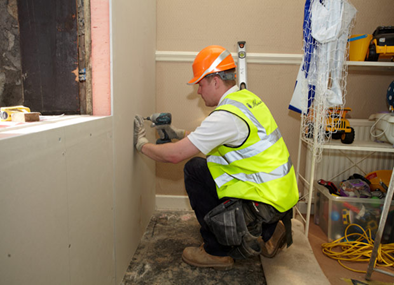
To insulate your cavity walls, the installer drills small holes around 22mm in size at intervals of around 1m in the outside wall of your home. The installer then blows insulation into the cavity using special equipment. Once all the insulation is in, the installer fills the holes in the brickwork so you’ll barely notice them.
Filling cavity walls is not a job you can do yourself, you will need to employ a registered installer. A professional can do the job in around two hours for an average house with easily accessible walls. It shouldn’t make any mess.
Costs and savings
Typical installation costs of cavity wall insulation vary depending on the size of your home. But whether you live in a large detached house or small flat, you should be able to make back the installation cost in five years or less due to the yearly energy bill savings you will make. As a rough guide, £800 is what you can expect to pay to install cavity wall insulation in a detached house. Annual energy savings could be as much as £200/ year on a detached home (EST).
You might be able to reduce these costs by carrying out the work at the same time as other home improvements or by not tackling the whole house at once.
Is cavity wall insulation right for your home?
If your house was built in the last 20 years or so, the walls are probably already insulated. To find out whether they are, you can do the following:
ask a registered installer for a borescope inspection. The installer will drill a small hole in your external wall to see if your walls are hollow or filled
check with your local authority’s building control department
Your home will be suitable for standard cavity wall insulation if it meets the following criteria:
its external walls are unfilled cavity walls
your cavity is at least 50mm wide, and is clear of rubble
the masonry or brickwork of your property is in good condition
the walls are not exposed to driving rain
your house is not at risk of flooding
You will need an installer to carry out a survey to check that your house is suitable. If so, they will then be able to insulate your walls using mineral wool or polystyrene beads.
If your house has narrow or uneven cavities, is in an exposed site or there is a risk of flooding, then it may be possible to fill the cavity with polyurethane foam. This is more expensive than standard cavity wall insulation but is a particularly effective insulator. You will need a specialist foam insulation installer to survey your home for this, and to carry out the work if suitable.
If you have any damp patches on your internal walls then they should not be insulated until the problem is resolved. Speak to a builder who specialises in damp prevention.
If your home’s external walls are joined to another house, the installer will need to insert a cavity barrier to contain the insulation so your neighbours aren’t affected.
Installers
The installer should be a member of one of the following organisations:
Check whether the installer is signed up to a code of professional practice and that the installation is guaranteed for 25 years by CIGA, or through an independent insurance-backed guarantee.
Insulating your solid walls could cut your heating costs considerably and make your home more comfortable.
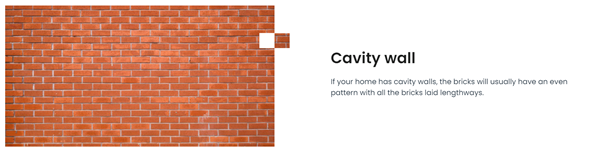
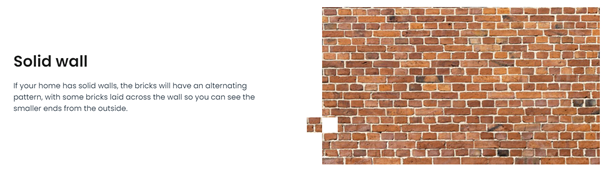
If your home was built before the 1920s, its external walls are probably solid walls rather than cavity walls.
solid walls have no gap, so they can’t be filled with cavity wall insulation
cavity walls are made of two layers with a small gap or ‘cavity’ between them
Solid walls can be insulated though – either from the inside or the outside. This will cost more than insulating a standard cavity wall, but the savings on your heating bills will be bigger too.
Internal Wall Insulation
Internal wall insulation is done by fitting rigid insulation boards to the wall, or by building a stud wall filled in with insulation material such as mineral wool fibre.
is generally cheaper to install than external wall insulation
will slightly reduce the floor area of any rooms in which it is applied (the thickness of the insulation is around 100mm)
can be quite disruptive, but can be done room by room
requires skirting boards, door frames and external fittings to be removed and reattached
can make it hard to fix heavy items to inside walls – although special fixings are available
Cannot be done before fixing any problems with penetrating or rising damp
External wall insulation
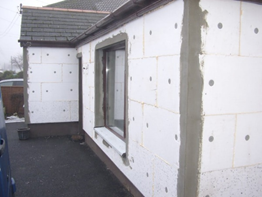
This involves fixing a layer of insulation material to the wall, then covering it with a special type of render (plasterwork) or cladding.
The finish can be smooth, textured, painted, tiled, panelled, pebble-dashed, or finished with brick slips.
External insulation:
can be applied without disruption to the household does not reduce the floor area of your home
will renew the appearance of outer walls
will improve weatherproofing and sound resistance
fills cracks and gaps in the brickwork, which will reduce draughts
increases the lifespan of your walls by protecting the brickwork
reduces condensation on internal walls and can help prevent damp (but will not solve rising or penetration damp)
best installed at the same time as external refurbishment work to reduce the cost
may need planning permission – check with your local council
requires good access to the outer walls
not recommended if the outer walls are structurally unsound and cannot be repaired
Moisture Movement and Ventilation
In traditionally built properties with solid walls, water vapour can usually move quite freely through the building. This is partly because of the high levels of ventilation and draughts, but also because water vapour can travel through the bricks and stones that the walls are made of. When you insulate an older building, you will change the way that water vapour behaves in several ways:
adding wall insulation will usually cut down on draughts through the walls and round the windows
the insulation may create a barrier to vapour movement, depending on what materials are used
adding insulation to the inside of a wall will make the wall colder. This means that any water vapour entering the wall from inside will get a lot colder, and may condense inside the wall
Whenever you fit solid wall insulation to a building you need to take account of water vapour to make sure that you don’t create new damp problems in the future. This may involve using “breathable” insulation materials that will allow the vapour to carry on permeating the walls, or it could involve creating a continuous vapour barrier to make sure no vapour can get into the walls from the inside. You will need an experienced specialist installer to develop a moisture control strategy that is specific to your building.
You should check with your installer that the installation is covered by an appropriate 25 year guarantee. They may be members of the SWIGA guarantee scheme, or they may offer an independent insurance-backed guarantee. You can find a list of Ofgem approved guarantee schemes.
Typical installation costs* of solid wall insulation can vary as follows:
external wall insulation: around £10,000
internal wall insulation: around £8,200
*Based on a typical semi-detached house in Great Britain
Over 20 years payback period for a gas heated UK detached home. However, off gas grid is more expensive to heat and therefore annual savings will be greater.
The costs we suggest for installing solid wall insulation are for paying a company to come in, insulate your whole house in one go, fully redecorate and replace everything just as it was.
If you’re looking to spend less, it is advisable to insulate a wall when you are having other building or decorating work done. Internal insulation can be fitted when you’re planning to redecorate anyway, or to fit a new kitchen or bathroom. You can also spread the cost by tackling one room at a time.
External insulation will also cost less if you fit it when you’re having other work done to the outside. If you’re having a new roof, or painting the windows, or even having solar PV panels fitted, then you will probably have scaffolding up already, which can save a bit on the costs. If your walls need repointing or other repair work, it’s worth getting a quote for a complete refurbishment including insulation – it will probably work out cheaper than doing the two things separately.
Sometimes there is financial support available to help with the cost of solid wall insulation.
Certified Installers:
We recommend you use a Solid Wall Insulation Guarantee Agency (SWIGA) certified installer for internal and external wall insulation. This may also be important for securing funding. See more about SWIGA and the up to date list of certified installers on their website here.
Financial help:
HEEPS ABS – Interior insulation grants for eligible households
Warmwowrks – all insulation types for eligible households
Home Energy Scotland – all insulation types loans and grants
Energy Company Obligation (ECO3) – all insulations for eligible households
We know that the Scottish Broadband Voucher Scheme (SBVS) can be confusing so we have made a Voucher Eligibility Flow Chart to help explain how it all works, as far as we understand through our research:
The beautiful nature of Finderne has given us much to be grateful for throughout the COVID lockdowns. Now, in celebration of Earth Day on Thursday, April 22nd, residents in Finderne are being invited to give back to nature in the form of RE-Fresh litter picks throughout April.
Our local litter problem is part of a larger troubling trend across Scotland that is wreaking havoc on marine wildlife and ocean waters around us. According to a 2020 Marine Scotland Science study, Scottish littering puts more than 1,000 tonnes of macro plastics into the sea annually and 90 percent of this is caused by land littering.
Zero Waste Scotland estimates half of all litter in Scotland could have been recycled. Scotland’s Deposit Return Scheme, which comes into effect in 2022 on Polyethylene terephthalate (PET), glass aluminum and steel containers, is expected to reduce the littler problem by a third. But that is not enough.
Finderne Development Trust member and Rafford resident Lisa Wolff is organising the socially distanced “RE-Fresh Finderne” litter pick now until April 27th, together with Nancy Hurst who is leading a concurrent “RE-Fresh Findhorn” litter pick from April 28th to April 30th. This community-wide effort already includes approximately 20 volunteers throughout Finderne, and builds upon frequent litter picking conducted by individuals throughout lockdown.
Lisa is passionate about waste reduction, serving on the board for Moray Waste Busters and running local business Bee Home Cottage with her husband John. “Our local walk takes us past a ditch that is filled with recyclable plastic and glass bottles and lots of cans,” said Lisa. “I could not ignore its impending harm to local or marine wildlife any longer, and had a feeling I wasn’t alone. So I contacted Finderne Development Trust and Moray Council to see if a community-wide cleanup might be possible.”
Nancy, a former resident of Rafford who runs a health and safety training company Parallel Training, now lives in Findhorn. She has a desire to keep her village free from litter, especially with the influx of visitors over the coming summer months. “I believe keeping the streets, trails and beaches free of litter encourages others to do the same,” said Nancy.
Together with the Moray Council, Finderne Development Trust are providing a range of supporting materials, including litter pickers, high-viz vests, gloves and clear and black bin bags to help separate rubbish from recyclables. Lisa is coordinating with volunteers and the Moray Council to have the rubbish and recyclables collected at designated pick-up points.
Clean-up efforts have already begun and will continue until Tuesday, April 27th in Finderne and Friday, April 30th for Findhorn, or as long as needed to cover all “adopted” sites. If you would like to volunteer for RE-Fresh Finderne, contact Lisa Wolff at beehomecottage@gmail.com or 07981177625. If you would like to join the RE-Fresh Findhorn volunteers, contact Nancy Hurst at 07912733716 or nancy@paralleltraining.co.uk.