
Job description
Application form download link below
Job description
Application form download link below
Get tickets here to join the AGM on the 9th of November on zoom. All FDT members are welcome.
28th of September, 2021
We are delighted to announce that Finderne Development Trust has received an enablement grant from the Scottish Government’s Community and Renewable Energy Scheme (CARES) * to contract with Locogen, a renewable energy consultancy company, to carry out a comparative evaluation of the various renewable energy options available in the vicinity of Rafford Village Hall.
This enablement project is part of FDT’s much larger project to develop community-led affordable housing in Brockloch, Rafford. The outcome of this enablement project will steer the development of appropriate renewable energy and energy efficient factors in the final design of the 12-unit affordable housing proposal at Brockloch.
The renewable options to be considered by Locogen include ground sourced energy from vertical boreholes in the development site itself or via a horizontal heat collection matrix from the recreation ground adjacent to Rafford Village Hall, and air source heat pumps.
During FDT’s initial community consultation in 2018 affordable housing was identified as being key in growing a vibrant, sustainable, and balanced community. FDT anticipates that the provision of community led affordable housing in Finderne will make a significant contribution to the community’s ability to attract and retain the economically and socially active families needed to support local services and businesses, and thereby act as a catalyst for rural regeneration within Finderne.
* “The Scottish Government’s Community and Renewable Energy Scheme (CARES)was established by the Scottish Government to encourage local and community ownership of renewable energy across Scotland and to help maximise the benefits to communities of renewable energy systems – whether commercial or community-owned.
CARES aims to accelerate progress towards the Scottish Government’s target of 2GW of renewable energy to be locally or community owned by 2030, and to assist with delivering the Scottish Government’s Energy Strategy through the provision of loan finance, grant funding and specialist advice. CARES is managed by Local Energy Scotland, a consortium made up of Energy Saving Trust, Changeworks, The Energy Agency, SCARF and The Wise Group, with support for delivery from Ricardo Energy & Environment and QMPF. For more information, visit www.localenergy.scot
Air Source Heat Pump
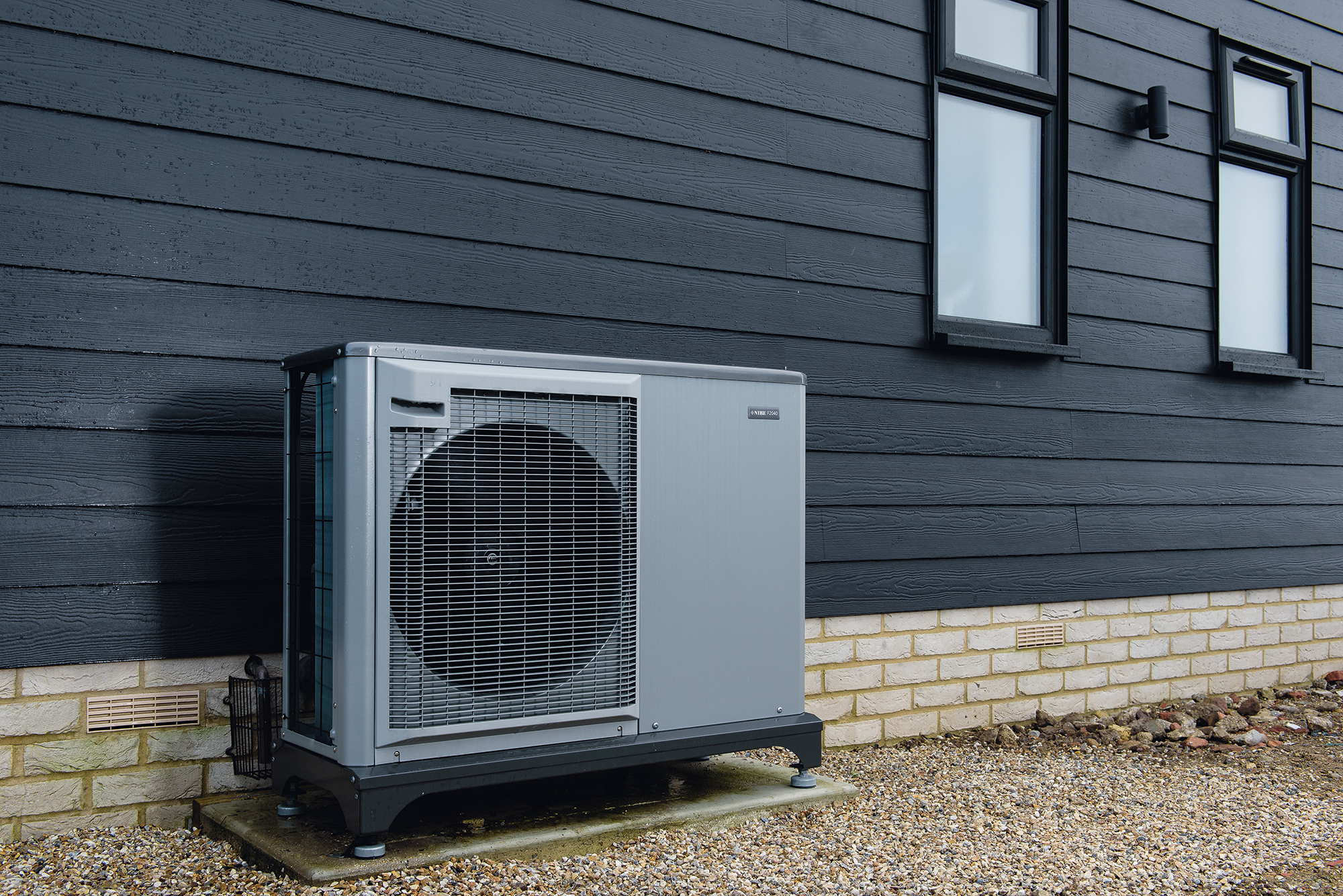
Air source heat pumps are becoming very popular and are being installed in many newbuilds and existing homes around the country. They are extremely efficient and produce more units of heat than they consume units of electricity. Air source heat pumps extract heat from outside air and concentrate it through the refrigeration process to heat your home. Heat pumps produce low grade heat (35 – 50 degrees centigrade) which is low than gas/oil central heating systems which usually flow at 60- 80 degrees centigrade. This reduction in heat requires greater surface area of radiation. Often households install underfloor heating and/or larger surface area radiators in order to maximise radiation of heat into the home. It is recommended that the building is well insulated and draught proofed before installing heat pumps as to prevent heat loss and gain their best efficiencies.
Ground Source Heat Pump

Ground source heat pumps use the same principles as air source heat pumps, except they use the ground to source the heat. Ground source heat pumps use underground tubing to extract heat from the ground which is then concentrated through the refrigeration process. Underground heat is more consistent year round compared to air temperature which drops in winter (when you need your heating most). The ground heat extraction can be laid horizontally if space is available at a depth of 1-2m or straight down a borehole if space is more limited. Ground source heat pumps cost more to install than air source heat pumps due to the groundworks and particularly where a borehole is required as specialised machinery is involved. The extra cost does offer efficiency gains over air source heat pumps and the government pay higher Renewable Heat Incentive (RHI) tariffs per kWh which can help combat the extra expense.
Biomass boiler

Biomass heating systems generate clean, green renewable heat by burning wood in the form of pellets, chips or logs. Burning wood in biomass boilers releases the same amount of carbon dioxide into the atmosphere as was absorbed while the plants or trees were growing. This makes biomass technology a carbon-neutral form of renewable energy.
A biomass boiler does exactly the same job as a conventional heating system – providing central heating and hot water – they just do so by burning wood or biological materials. There are 2 types of biomass boiler which are differentiated by whether the fuel is fed to the boiler manually or automatically. Manual models will mean that you have to feed the fuel into the boiler yourself, and also clean out the ash each week. Automatic biomass boiler on the other hand, take care of the cleaning and refuelling themselves. However, biomass boilers take up much more space than conventional boilers so aren’t the most suitable renewable technology for all homes.
Solar Thermal

A solar thermal heating system uses the sun’s heat to warm water for your home. This hot water can be used to supply your wet central heating system, taps and showers. So you won’t be using your boiler so much which will save you money. However, solar thermal alone is unlikely to be able to meet your total hot water demand. On average, solar thermal owners find they get between 40-70% of their hot water with free solar energy. The rest needs to be topped up by the boiler. Solar thermal panels look very similar to solar PV panels but they turn the sun’s energy into heat rather than electricity. They are usually fitted to a roof where they will absorb the most sunlight. And each panel includes tubes of fluid which, when exposed to sunlight, absorb the sun’s heat. This fluid travels down into your home where the heat passes through an exchanger coil to heat water in a cylinder.